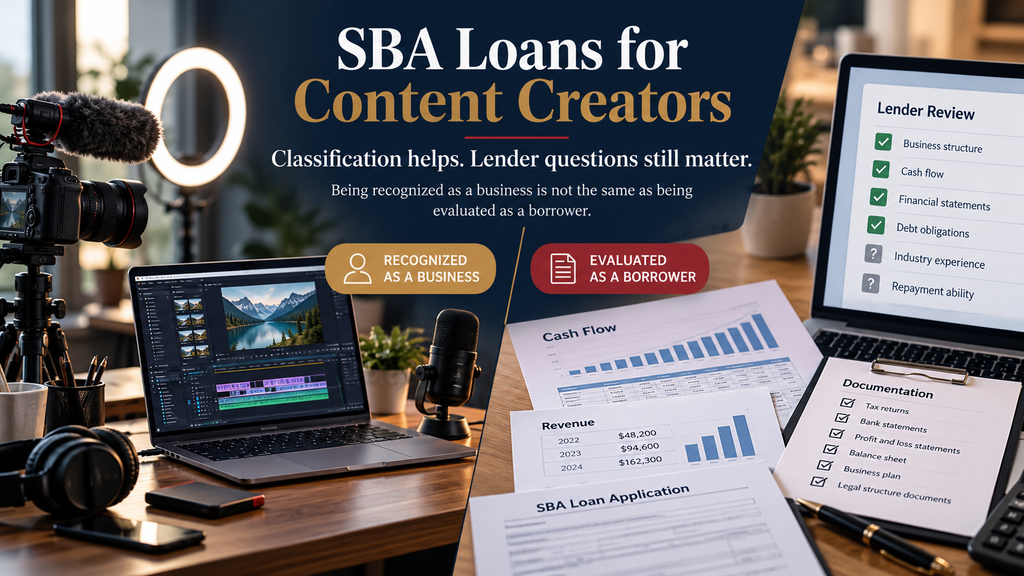
The SBA has clarified where qualifying creator businesses fit within its industry classification system. But that doesn’t necessarily change what happens when a creator asks a lender for money.
On October 15, 2026, the Small Business Administration announced guidance directing qualifying content creators toward NAICS 5121, the industry group for Motion Picture and Video Industries.
The announcement includes podcasters, streamers, filmmakers, gamers, digital publishers, social-media entrepreneurs, and other qualifying businesses producing and distributing original audiovisual content.
For creators, this is an important acknowledgment of how businesses have evolved. But there is a question worth asking:
Does recognizing your business change how a lender evaluates it?
TL;DR The SBA has provided clearer classification guidance for qualifying content creators under NAICS 5121. But clearer classification doesn’t change the fundamental questions a lender considers when evaluating a financing request. Revenue, cash flow, repayment capacity, documentation, and the lender’s own credit requirements still matter.
For creator businesses, understanding the difference between being recognized as a business and being evaluated as a borrower is important before applying.
The SBA classification is not a credit decision
A NAICS classification tells the SBA and other organizations what kind of economic activity a business primarily conducts. It does not tell a lender whether that business can repay a loan.
Those are two separate evaluations.
The SBA can clarify where a creator business belongs within its classification framework without changing an individual lender’s credit policy.
And while creators may now have clearer direction regarding classification, they still face the same fundamental questions other business owners encounter when seeking financing.
Do followers matter when a content creator applies for a business loan?
Imagine a creator with 250,000 followers, a successful podcast, several sponsorship agreements, and income from multiple platforms.
From the outside, this may look like a thriving business.
But what does the lender actually see?
The lender may examine how much revenue the business generates, how consistently that revenue arrives, what expenses are required to sustain operations, and whether the remaining cash flow supports repayment.
A large audience may contribute to the creator’s business value, but audience size alone does not establish repayment capacity. That’s an important distinction.
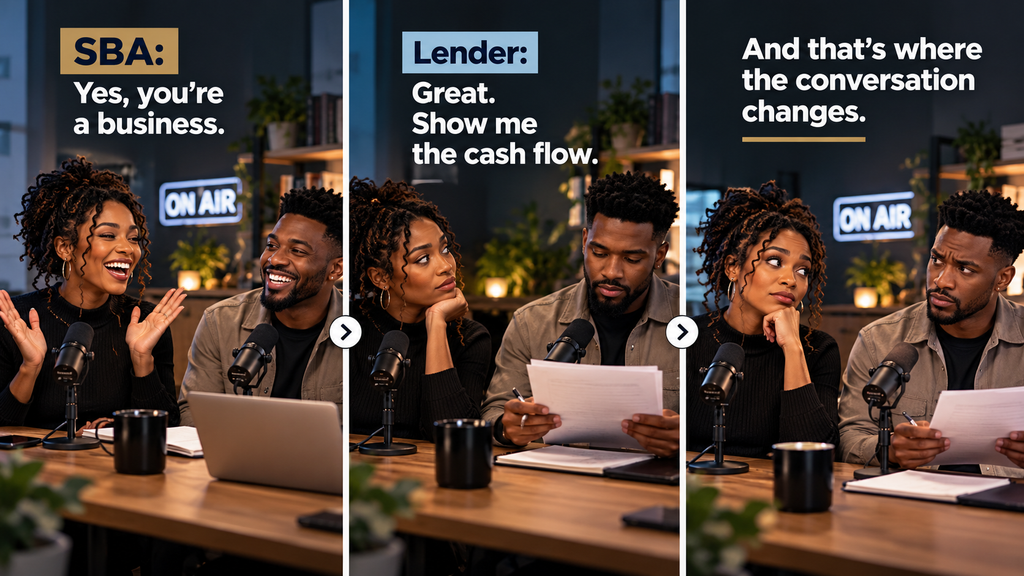
How will a lender look at creator revenue?
Many creators earn income from several sources.
That doesn’t automatically make the business financially weak.
One month might include a substantial brand partnership payment. Another might rely primarily on advertising revenue and subscription income.
However, it changes the questions a lender may need to answer.
How much revenue is recurring?
How much depends on individual contracts?
What happens if a major sponsorship ends or a platform changes its monetization policies?
Can the business document its revenue history?
The lender is not simply looking at how much money the creator has earned. The lender is evaluating how that income supports the business’s financial obligations and proposed debt repayment.
How do content creators document income for a lender?
A creator may have a legitimate, profitable business and still encounter difficulty presenting its financial information.
Revenue may arrive from payment processors, advertising networks, subscriptions, sponsorship agreements, and platform distributions.
The question becomes whether that revenue can be consistently documented and reconciled with the business’s financial records.
For example, deposits into a bank account don’t necessarily tell the lender everything about the source of the income, the associated expenses, or the sustainability of the revenue.
This is where understanding lender logic becomes important.
A creator’s business model may be different from that of a traditional retailer or service company, but the lender must still evaluate the business’s capacity to repay.
So what actually changed?
The SBA has provided clearer classification guidance for qualifying creator-led businesses.
It has not established that all creator businesses qualify for SBA financing, nor has it announced a universal change to lender credit standards.
Individual lenders continue to evaluate financing requests according to applicable SBA program requirements and their own credit policies.
The creator’s classification and the creator’s financial profile are two different considerations.
Think Like The Lender
When you build a business around your creativity, your audience, and your ability to produce valuable content, it’s natural to see that business through the work you’ve accomplished.
But when you approach a lender, the business is evaluated through its financial performance, repayment capacity, documentation, and risk characteristics.
The SBA’s clarification may help establish where certain creator businesses belong.
What it doesn’t answer is what the lender will see when those businesses seek financing.
And that is the question worth understanding before you apply.
Want to understand what the SBA’s new creator classification means for your business?
We’ve covered the lender side here.
SBA Mastery has prepared a free NAICS 5121 Creator Cheat Sheet explaining the classification guidance, the types of creator businesses it may apply to, and what the SBA clarification does and does not change.
Get the Free Creator Classification Cheat Sheet
Source: U.S. Small Business Administration, October 15, 2026, “SBA Issues Historic Guidance to Recognize America’s Content Creator Economy.”
This article discusses common lender evaluation considerations; not new requirements imposed on creator businesses by the October 15 SBA announcement.